
The framework
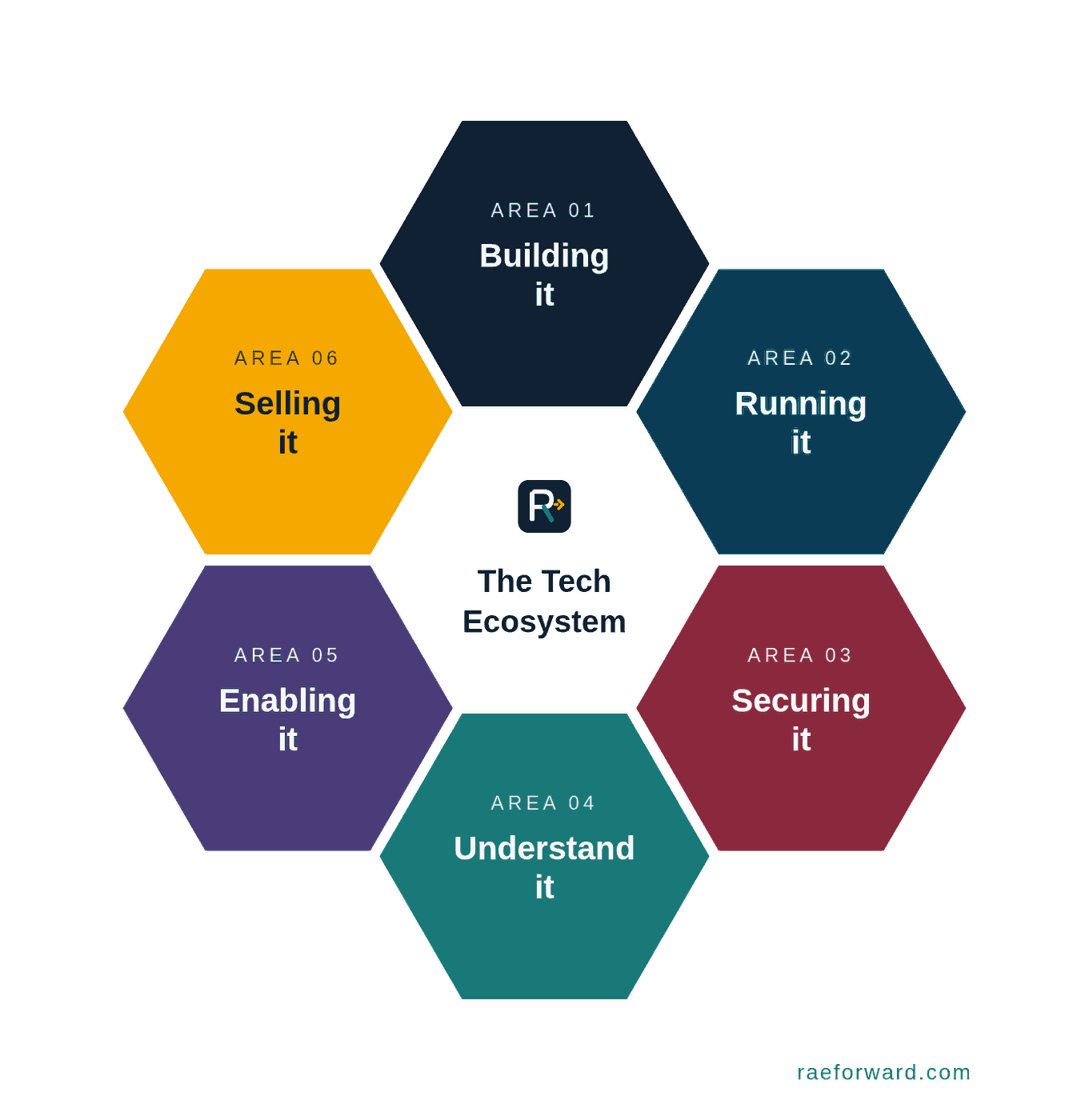
Tech is not one thing. It is six.
Six distinct areas, each with its own culture, its own roles, and its own kind of people. They all connect and depend on each other to make technology work.
How to read this
You are not looking for a perfect match.
You are looking for resonance.
Read through each area and notice which descriptions make you lean forward. Most people find one or two that feel immediately familiar, and one or two that feel completely out of reach. Both reactions are useful information.
As you read, think about your current or previous roles. Where do your day-to-day tasks already sit? Where would you like them to sit?
There are no right or wrong answers. The goal is not to pick the most impressive-sounding area.
Area 01
Building it
Creating technology. Designing systems, building applications, and solving technical problems. This is the area most people picture when they think of a career in tech. It involves writing code, designing architecture, and building the products and platforms that everything else depends on.
Of the six areas, this is the one that most commonly requires formal technical training. That does not make it off limits, but it does mean it is a longer journey for most career changers. The good news is that the other five areas are genuinely open to you right now.
Example roles
Software Developer · Solutions Architect · Cloud Engineer · DevOps Engineer · No-Code / Low-Code Developer
Area 02
Running it
Supporting and maintaining technology. Helping users, fixing issues, and keeping systems running. One of the most common entry points into tech, and a brilliant way to learn how organisations actually operate. You become the person people rely on when things go wrong, which means you build knowledge and credibility fast.
You do not need to have built the technology to be excellent at running it. Patience, clear communication, and the ability to stay calm under pressure matter far more than technical knowledge when starting out. Many people who now lead IT departments began their careers here.
Previous experience in customer-facing roles, administration or operations is a strong foundation for this area.
Example roles
IT Support Analyst · Service Desk Analyst · Infrastructure Manager · Service Manager · Operations Manager
Area 03
Securing it
Protecting systems, data and users. Monitoring threats, managing access, and investigating issues. Suits detail-oriented people who think carefully about risk and hold themselves and others to a high standard. Cybersecurity is one of the fastest-growing areas in tech globally, and demand significantly outpaces supply.
Not all security roles are deeply technical. Governance, risk and compliance work, the rules, policies and audit processes that keep organisations safe and legal, is heavily people-focused. If you have worked in a regulated environment, you may already have more relevant experience than you realise.
A background in compliance, policy, audit or any regulated industry is highly transferable into this area.
Example roles
GRC Analyst · Cybersecurity Analyst · SOC Analyst · Data Protection Officer · Information Security Manager
Area 04
Understand it
Working with data and information. Analysing, reporting, and identifying trends. Suits people who enjoy spotting patterns and turning information into something useful. Data is now one of the most valuable assets any organisation holds, and the ability to make sense of it is in demand across every industry.
You do not need to be a mathematician. You need to be curious, methodical, and good at asking the right questions. Tools like Excel, Power BI and SQL are learnable. The instinct to question the data, to ask what it is really telling you, is the harder skill to teach, and you may already have it.
Experience in research, reporting, finance, or any role where you have regularly worked with numbers or evidence is a strong starting point.
Example roles
Data Analyst · Business Analyst · BI Analyst · UX Researcher · Reporting Analyst
Area 05
Enabling it
Planning how technology is introduced, supporting change, and helping people get real value from it. The technology itself is rarely the hardest part of a digital project. Getting people to understand it, trust it, and actually use it is. The roles in this area make the difference between a tool that sits unused and one that transforms how an organisation works.
This is the area where experience from outside tech is not just useful, it is a genuine advantage. Teaching, managing, coordinating, facilitating, training. If you have ever helped people navigate change or get to grips with something new, you have already been doing this work.
Any background in people management, training, project coordination or communication maps directly into this area.
Example roles
Project Manager · Change Manager · IT Trainer · Digital Adoption Specialist · Digital Transformation Lead · Programme Manager
Area 06
Selling it
Communicating the value of technology to customers. Understanding their challenges and helping shape the right solutions. You do not need deep technical knowledge to do this well. You need to understand problems, listen carefully, build trust quickly, and communicate clearly. Many of the highest earners in tech work in this area and never write a line of code.
Sales in tech is not the stereotypical hard sell. At its best it is consultative, helping organisations work out what they actually need rather than pushing products at them. It rewards people who are curious, credible, and genuinely interested in solving other people’s problems.
A background in retail, recruitment, estate agency, financial services or any client-facing role is a strong foundation here.
Example roles
Account Manager · Pre-Sales Consultant · Business Development Manager · Customer Success Manager
Found one that feels familiar?
The book goes into all six areas properly, with fifty roles explained, what they actually pay, and what you would need to learn to move into each one.